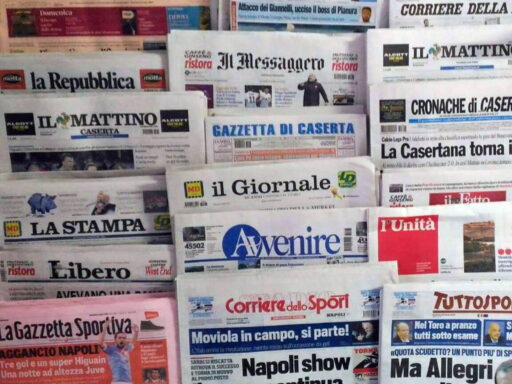

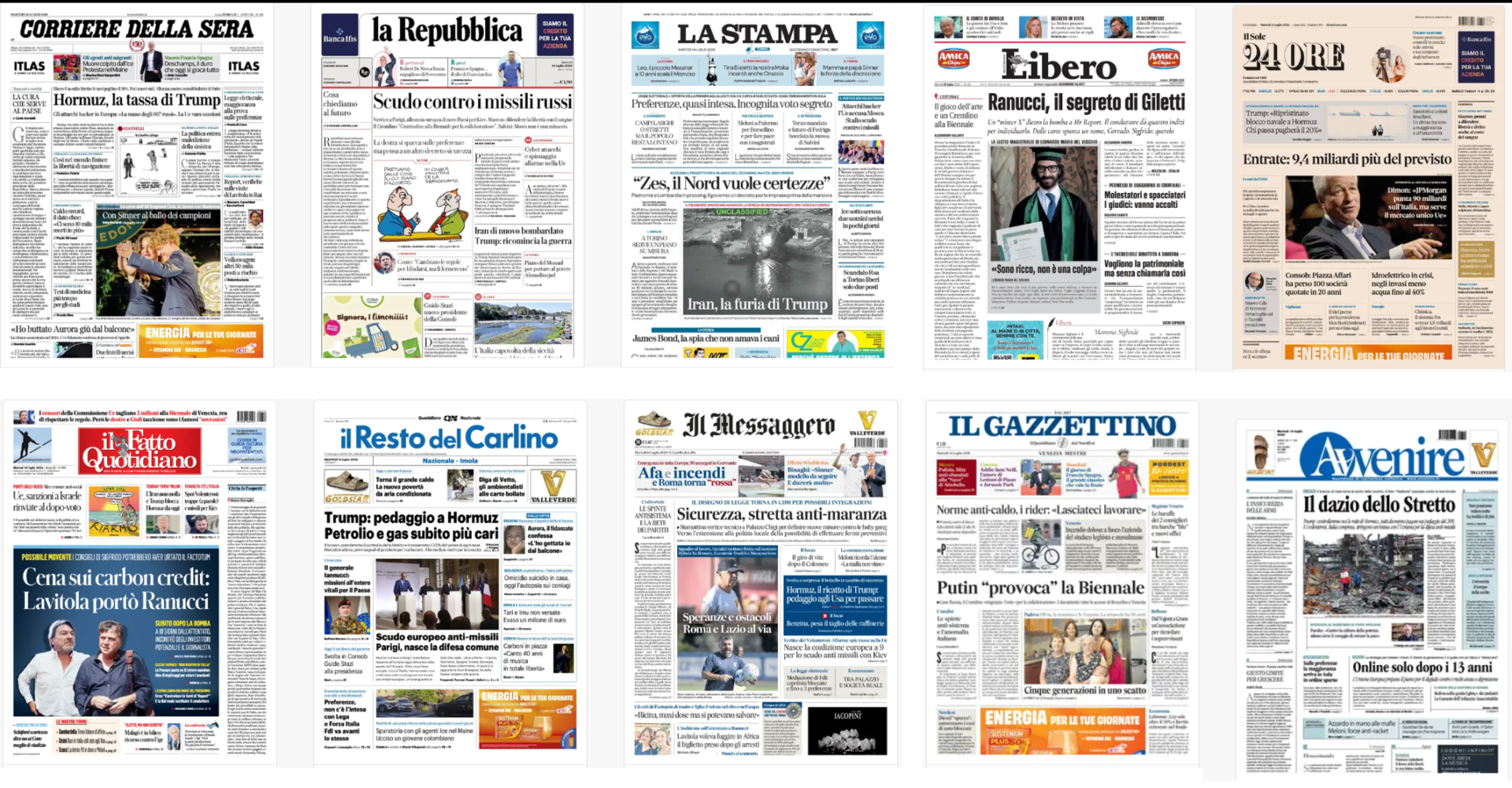

Do Italians read newspapers? And how much do Italian newspapers sell in 2026? The trend in sales and readership of the main national newspapers continues to reflect a profound transformation in the press sector, driven by changing consumption habits and the rise of digital media. In 2025, more than 30 million Italians read or browsed a newspaper, in print or digital replica, equal to 57.6% of the population over 14, according to the Audicom 2025/III survey. Even today, therefore, more than half of Italians still regularly engage with printed newspapers, although there is an ongoing decline, already noted by Lelio Simi in the 2025 Digital Journalism Report: “In Italy over the last three years, the rate of decline in copies sold has stabilized at -10%, a figure clearly higher than the global newspaper market, which is around 4–5%.”
1.3 million newspapers sold every day
In the first half of 2025, the average daily sales of newspapers, both print and digital, were about 1.3 million, confirming a downward trend compared with previous years. While waiting for the new data at the end of 2025, the decline is confirmed compared with 2024, when the daily average was about 1.36 million copies.
Looking at the latest circulation data available, published in March 2026 by Prima Comunicazione, for the period from January 2026 to December 2025, the Corriere della Sera remains the best-selling newspaper, with 208,605 copies (print plus digital), up slightly by 0.31%. Behind it is la Repubblica, second with 120,998 copies, down 1.72%.
Third is Gazzetta dello Sport, with 119,361 copies, down 1.25%. Il Sole 24 Ore also fell: -6.30% compared with December, to 108,878 copies. On the other hand, Il Mattino grew by 5.69%, Corriere dello Sport-Stadio by 3.47%, L’Unione Sarda by 2.37%, il Messaggero by 1.41%, QN-Il Resto del Carlino by 1.36%, and, above all, il Fatto Quotidiano, with a jump of almost ten percentage points (+9.61%).
Men prefer digital
The integration of print and digital is now standard practice, with national news outlets increasingly adopting digital-first commercial models, favoring the promotion of the digital newspaper over the edition sold in newsstands, and introductory offers, promotions that attract new customers by offering them a reduced price, a free trial, or a special package for a limited period. Audipress explains that the digital edition of newspapers is chosen mainly by men (53.9%), with the most active age group between 25 and 44 years old (35.8%). The 14–24 segment represents 15.7%, while those over 45 account for the remaining 48.5%.
Italians love periodicals
Weekly and monthly magazines, by contrast, attract mainly women: Italian weeklies reach 8.1 million readers, of whom 67.4% are women and 32.6% men, while monthlies reach 7.2 million readers (55% women). Reading frequency for weeklies remains high in 51.6% of cases, and monthlies maintain an average share of 41.8%, with balanced distribution across age groups. The structural crisis of the distribution network and strong digital competition are making life difficult for traditional publishers, which are forced to reinvent themselves with subscription models, innovative pricing, and greater use of digital offers. To maintain profitability and enhance information, publishing activity is increasingly supported by ongoing press office strategy and broad use of brand journalism and brand extension, leading publishers to also offer training courses and trips.
STAMPA FINANZIARIA provides content for corporate websites and blogs, press office and corporate communication services, brand journalism projects, and advertising and marketing copy.
—